
Best AI Email Builder: 5 Picks for 2026
Designing professional email campaigns no longer requires manual HTML coding or hiring a developer. AI email builders now allow you to describe your vision in plain language—and watch it come to life as production-ready code. From complex layout generation to brand-consistent styling, artificial intelligence handles the heavy lifting so you can focus on your business strategy.
In this guide, we compare five leading AI email builders based on their automation depth, ease of use, and output quality. Whether you are a solopreneur, a design agency, or a high-growth startup, these tools help you go from concept to inbox faster than ever before.
| Tool | AI Features | Output Type | Customization | Typical User |
|---|---|---|---|---|
| Migma.ai | Prompt-to-code, Figma sync, live edit | Production HTML | High (code-level) | Agencies & SaaS |
| Mailjet | AI template generator, copywriter | Campaign templates | Medium (template-based) | Small business owners |
| Postcards | Modular design, AI writing assistant | Modular HTML | Medium (no-code) | Designers & marketers |
| Stripo | AI modular system, AMP support | Interactive HTML | High (technical) | Marketing teams |
| beehiiv | Brand voice, layout generation | Newsletter emails | Limited (template-based) | Content creators |
How We Picked the Winners
To identify the top AI email builders for 2026, we evaluated each platform across five key dimensions:
- Speed to launch – How quickly a user can go from a text prompt to a finished HTML export.
- Customization and control – Whether users can move beyond basic templates to create unique, on-brand designs.
- AI depth – The level of automation, from simple copy assistance to full email structure generation.
- Integration and export – How easily the output works with major Email Service Providers (ESPs).
- Real-world usability – The balance between AI-powered convenience and manual creative control.
1. Migma.ai
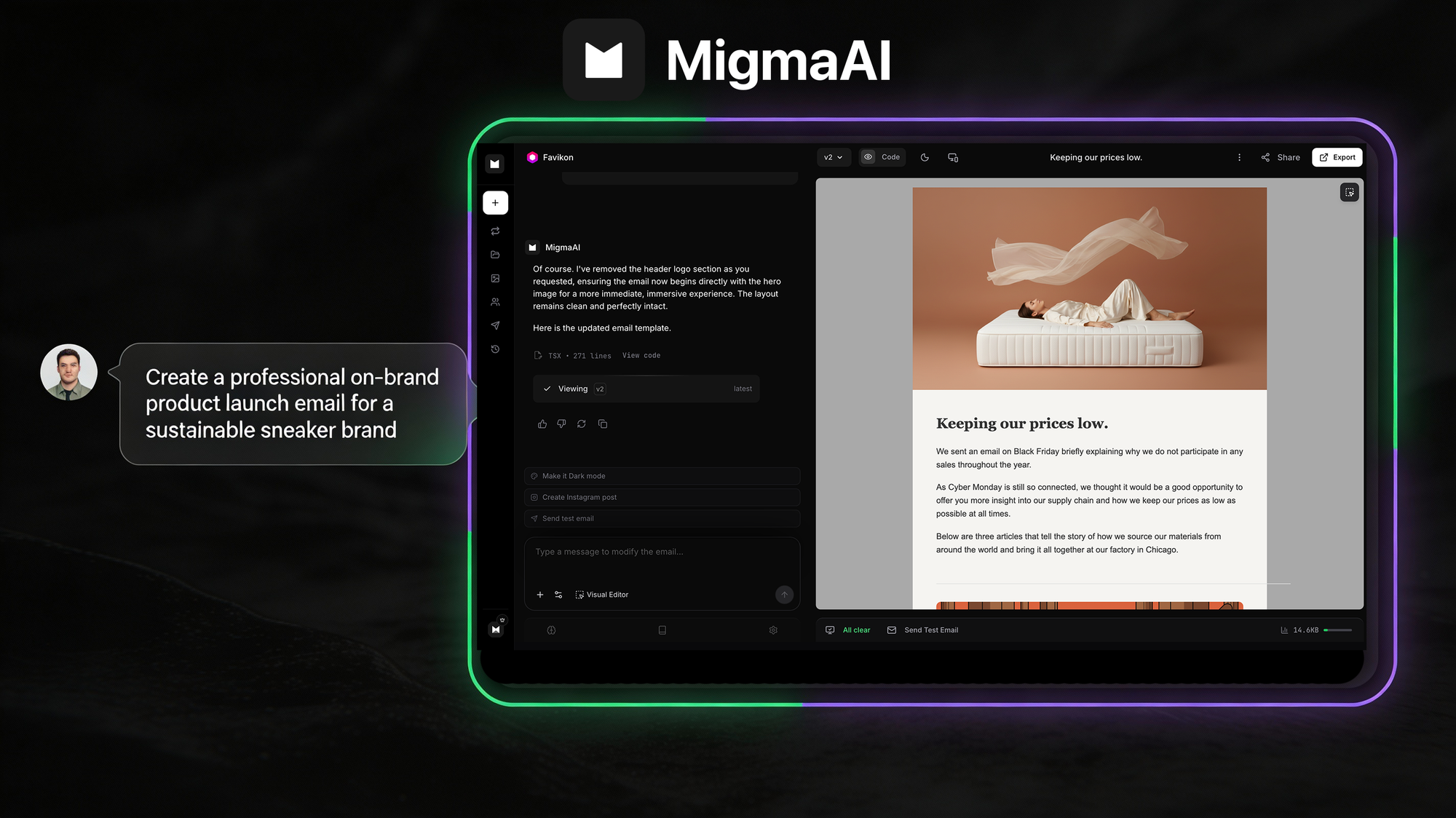
Migma.ai converts natural language descriptions into professional, pixel-perfect email templates using advanced AI code generation. Functioning as the "Lovable for email," it allows users to describe their layout needs and receive clean, production-ready HTML and CSS instantly.
When you provide a prompt, Migma generates the complete structure, imagery, and content automatically. The building process is entirely conversational, allowing you to refine specific sections through additional instructions or by using visual editing tools that update the underlying code in real-time.
Key Features
- Natural language processing that converts written instructions into production-ready code
- Deep Figma-to-Email synchronization for maintaining high-fidelity design standards
- Live visual editing for post-generation modifications without touching the source code
- AI Email Preflight for automated testing across various mobile and desktop clients
- Direct export to major sending platforms like Mailchimp, HubSpot, and Braze
Pros
- Generates high-quality, professional code that surpasses standard templates
- Offers extreme speed from initial concept to final export
- Allows for high customization through direct code access or visual tools
- Handles complex brand logic and asset management effortlessly
Cons
- Results depend heavily on prompt clarity and specificity
Pricing
- Free: $0/month, limited exports, public projects, basic AI features
- Pro: $35/month, unlimited projects, private workspace, custom domains
- Teams: $99/month, adds team collaboration, advanced permissions, and SSO
2. Mailjet
Mailjet combines a user-friendly interface with AI assistance to help small businesses scale their email marketing. Its AI template generator asks questions about your industry and goals to create initial structures and copy.
The platform focuses on all-in-one convenience, offering both the builder and the sending infrastructure in a single package. Beyond creation, Mailjet provides AI tools for subject line optimization and predictive analytics to help improve open rates over time.
Key Features
- AI-driven campaign generation based on business type and campaign goals
- Collaborative real-time editor for marketing teams to work together
- Integrated sending platform with strong deliverability optimization tools
Pros
- Quick setup with guided AI assistance
- Integrated business tools and marketing features
- No technical knowledge required to launch professional campaigns
Cons
- Template selection locks users into specific design frameworks
- Less flexibility for unique or highly complex layout requirements
Pricing
- Free: $0/month, 6,000 emails/month, basic features
- Essential: ~$15/month, 15,000 emails, no Mailjet logo
- Premium: ~$25/month, marketing automation, A/B testing
- Custom: Tailored pricing for high-volume enterprise needs
3. Postcards (by Designmodo)
Postcards is a modular email builder that uses AI to help designers stack pre-designed blocks into a cohesive layout. It prioritizes no-code design speed, allowing users to focus on visual arrangement while the AI handles the HTML structure.
The platform includes an AI writing assistant to generate compelling copy for each module. Its primary strength lies in its clean export capabilities, supporting over 70 different email service providers to ensure your design looks the same regardless of where it is sent.
Key Features
- Modular drag-and-drop system for rapid layout building
- AI writing assistant for modular content generation and tone adjustment
- Brand presets for maintaining consistent colors and typography across campaigns
Pros
- Clean HTML output that works across all major email clients
- Ideal for quick prototyping and testing design ideas
- Extensive library of professional pre-designed modules
Cons
- Customization options are more limited than code-generating platforms
- Requires an external service to send the generated emails
Pricing
- Free: $0/month, limited modules and exports
- Business: $18/month, unlimited templates, AI assistant
- Agency: $29/month, adds team collaboration and priority support
4. Stripo
Stripo is a technical favorite for marketing teams that need deep control over their email HTML and interactive elements. Its AI modular system allows users to create reusable blocks that the AI can then use to generate new emails based on simple text prompts.
The platform provides a split-view editor, where users can use the drag-and-drop interface on one side and see the code update on the other. This makes it a bridge between simple builders and custom development for those who need technical precision.
Key Features
- AI-powered content blocks for reusable and automated design elements
- Integrated AI image generation and text refinement tools
- Support for interactive components such as carousels and accordions
Pros
- Advanced control over code for technical users and developers
- Speeds up production by up to 60% with modularity
- Excellent integration with a vast ecosystem of ESPs
Cons
- Steeper learning curve compared to simple "prompt-to-email" tools
Pricing
- Free: $0/month, 1 template, 5 exports
- Standard: $15/month, unlimited templates, 50 exports
- Pro: $45/month, unlimited exports, team collaboration
5. beehiiv
beehiiv is built specifically for the newsletter economy, focusing on brand voice and subscriber growth. Its AI tools are optimized for long-form writing, helping creators generate outlines, subject lines, and full newsletter drafts that maintain a human tone.
Unlike design-heavy builders, beehiiv focuses on readability and engagement. It includes built-in growth tools like referral programs and ad networks, making it a complete ecosystem for digital publishers who want to monetize their audience.
Key Features
- AI brand voice analyzer for consistent newsletter tone
- Automated layout adaptation based on content length and type
- Integrated growth and monetization tools for independent creators
Pros
- Best-in-class features for long-form content and newsletters
- Strong focus on subscriber growth and data analytics
- Generous free tier for new creators to start for free
Cons
- Limited design flexibility for traditional e-commerce or promotional emails
Pricing
- Launch: $0/month, up to 2,500 subscribers
- Scale: $39/month, custom domains, advanced analytics
- Max: $99/month, priority support, API access
How to Choose the Right AI Builder?
Choose your AI email builder based on your team's specific workflow rather than just a list of features. Here is a simple framework to help you decide:
- Technical Comfort: If you want the power to "describe-to-code," Migma.ai is the clear leader. If you want guided simplicity, look at Mailjet or beehiiv.
- Email Purpose: Use beehiiv for long-form newsletters, or Stripo for highly interactive e-commerce campaigns.
- Portability: If you need to export your designs to many different platforms, Postcards or Migma offer the cleanest, most portable code.
- Test First: Most platforms offer free tiers. Verify that the AI's design style and code quality match your brand standards before committing to a paid plan.
The ideal builder eliminates the technical gap between your vision and a live campaign. Start with a clear prompt, pick the tool that matches your skill level, and launch your first AI-generated campaign today.
Designing a professional email campaign no longer requires learning HTML or hiring a specialized developer. AI email builders now let you describe what you want in plain language—and watch it come to life. From modular layout generation to advanced code-level customization, artificial intelligence handles the heavy lifting so you can focus on your audience and conversion strategy.
In this guide, we compare five leading AI email builders based on their output quality, ease of use, and level of automation. Whether you are a solo creator, a high-growth startup, or a technical agency, these tools help you go from idea to inbox faster than ever before.
How We Picked the Winners
To identify the top AI email builders for 2026, we evaluated each tool across five key dimensions:
- Speed to launch – How quickly a user can go from a text prompt to a finished HTML export.
- Customization and control – Whether users can move beyond basic templates to create unique, on-brand designs.
- AI depth – The level of automation, from simple copy assistance to full email structure generation.
- Integration and export – How easily the output works with major Email Service Providers (ESPs).
- Real-world usability – The balance between AI-powered convenience and manual creative control.
1. Migma.ai
Migma.ai converts natural language descriptions into professional, pixel-perfect email templates using AI-powered code generation. It functions as the "Lovable of email," allowing users to describe their vision and receive clean, production-ready HTML and CSS instantly (see the generated image above).
When you describe your campaign goals, Migma generates the complete structure and content automatically. The building process runs through conversational prompts, allowing you to refine results through additional descriptions or by using live visual editing tools that update the code in real-time
Key Features
- Natural language processing that converts written instructions into production-ready email code
- Deep Figma-to-Email synchronization for maintaining high-fidelity design
- Live visual editing for post-generation modifications without touching code
- AI Email Preflight for testing responsiveness across various email clients
- Direct export to major ESPs like Mailchimp, HubSpot, and Braze
Pros
- Generates high-quality, professional code beyond standard templates
- Offers extreme speed from concept to final export
- Allows for high customization through direct code access or visual tools
Cons
- Results depend on prompt clarity and specificity
Pricing
Migma.ai offers three pricing tiers:
- Free: $0/month, limited exports, public projects, basic AI features
- Pro: $25/month, unlimited projects, private workspace, custom domains
- Teams: $50/month, adds team collaboration, advanced permissions, and SSO
2. Mailjet
Mailjet combines a user-friendly interface with AI assistance to help small businesses scale their email marketing. Its AI template generator asks questions about your industry and goals to create initial site structures and content.gmass+1
The platform focuses on "one-stop" convenience, offering both the builder and the sending infrastructure in one package. Beyond creation, Mailjet provides AI tools for subject line optimization and predictive analytics to improve open rates.omr+1
Key Features
- AI-driven campaign generation based on business informationwoodpecker
- Collaborative real-time editor for marketing teamsgmass
- Integrated sending platform with strong deliverability toolsomr
Pros
- Quick setup with guided AI assistancewoodpecker
- Integrated business tools and marketing featuresomr
- No technical knowledge requiredgmass
Cons
- Template selection locks users into specific design frameworksgmass
- Less flexibility for unique or highly complex business requirementswoodpecker
Pricing
Mailjet offers four plans:sender
- Free: $0/month, 6,000 emails/month, basic features
- Essential: ~$15/month, 15,000 emails, no Mailjet logo, online support
- Premium: ~$25/month, marketing automation, A/B testing
- Custom: Tailored pricing for high-volume enterprise needs
3. Postcards (by Designmodo)
Postcards is a modular email builder that uses AI to help designers and marketers stack pre-designed blocks into a cohesive layout. It prioritizes "no-code" design speed, allowing users to focus on the visual arrangement while the AI handles the underlying HTML structure.slashdot+2
The platform includes an AI writing assistant to help generate compelling copy for each module. Its primary strength lies in its clean export capabilities, supporting over 70 different email service providers.slashdot
Key Features
- Modular drag-and-drop system for rapid layout buildingdesignmodo
- AI writing assistant for modular content generationdesignmodo
- Brand presets for consistent colors and typographyslashdot
Pros
- Clean HTML output that works across all major email clientsdesignmodo
- Ideal for quick prototyping and testing design ideasslashdot
- Extensive library of professional pre-designed modulesdesignmodo
Cons
- Customization options more limited than code-generating platformsdesignmodo
- Requires an external ESP to send the generated emailsslashdot
Pricing
Postcards offers three tiers:
- Free: $0/month, limited modules and exports
- Business: $18/month, unlimited templates, AI assistant
- Agency: $29/month, adds team collaboration and priority support
4. Stripo
Stripo is a technical favorite for marketing teams that need deep control over their email HTML and interactive elements like AMP. Its AI modular system allows users to create reusable blocks that the AI can then use to generate new emails based on simple text prompts.skywork+1
The platform provides a split-view editor, where users can use the drag-and-drop interface on one side and see the code update on the other. This makes it a bridge between simple builders and custom development (see the generated image above).unlayer+1
Key Features
- AI-powered content blocks for reusable design elementsskywork
- Integrated AI image generation and text refinementskywork
- Support for interactive AMP for Email componentsskywork
Pros
- Advanced control over code for technical usersunlayer
- Speeds up production by up to 60% with modularityskywork
- Excellent integration with a vast ecosystem of ESPsskywork
Cons
- Steeper learning curve compared to simple "prompt-to-email" toolsunlayer
Pricing
Stripo offers three plans:woodpecker
- Free: $0/month, 1 template, 5 exports
- Standard: $15/month, unlimited templates, 50 exports
- Pro: $45/month, unlimited exports, team collaboration
5. beehiiv
beehiiv is built specifically for the newsletter economy, focusing on brand voice and content growth. Its AI tools are optimized for long-form writing, helping creators generate outlines, subject lines, and even full newsletter drafts that sound human.beehiiv+1
Unlike design-heavy builders, beehiiv focuses on readability and subscriber engagement. It includes built-in growth tools like referral programs and ad networks, making it a complete ecosystem for digital publishers.emailtooltester+1
Key Features
- AI brand voice analyzer for consistent newsletter toneemailtooltester
- Automated layout adaptation based on content lengthbeehiiv
- Integrated growth and monetization tools for creatorsemailtooltester
Pros
- Best-in-class features for long-form content and newslettersemailtooltester
- Strong focus on subscriber growth and data analyticsbeehiiv
- Generous free tier for new creatorsemailtooltester
Cons
- Limited design flexibility for traditional e-commerce or promotional emailsemailtooltester
Pricing
beehiiv offers three tiers:emailtooltester
- Launch: $0/month, up to 2,500 subscribers
- Scale: $39/month, custom domains, advanced analytics
- Max: $99/month, priority support, API access
How to Choose the Right AI Builder?
Choose your AI email builder based on your team's workflow and goals, not just feature lists. Here is a simple framework:
- Technical Comfort: If you want "describe-to-code" power, Migma.ai is the choice. If you want guided simplicity, look at Mailjet.producthunt+1
- Email Purpose: Use beehiiv for newsletters, or Stripo for highly interactive e-commerce campaigns.skywork+1
- Flexibility: If you need to export to many different platforms, Postcards or Migma offer the most portable code.migma+1
- Test First: Most platforms offer free tiers. Verify that the AI's design style matches your brand before committing to a paid plan.aichief+1
The ideal builder eliminates the technical gap between your vision and a live campaign. Start with a clear idea, pick the tool that matches your skill level, and launch your first AI-generated campaign today.